Thank you.
When the dread, the shock, the upset and the tributes all subside, gratitude remains the enduring feeling.
I came to Federer “late”. Or so I thought in 2007, when he was en route to his 10th slam at the Australian Open. The man was in his late 20s, number 1 in the world. There were suggestions that he was going to break Sampras’ record of 14 grand slams. There were whispers that he was looking vulnerable because – shock horror – he lost to Roddick at Kooyong. That was the landscape when I turned on my TV one fateful night to watch the men’s semifinal in 2007 between Federer and Roddick.
I was indifferent to both. If anything, I didn’t mind the idea of a Roddick upset, a fitting ending where Roddick finally gets one against an old foe. But what subsequently transpired in the match made me forget that notion altogether. I don’t remember how I watched or reacted during the match. What I remember was the surreal fog that descended. In a dream like state, I finally understood why Federer inspired both awe and adoration. To this day, I remember stroke for stroke the entirety of the second set, in which Federer obliterated a red hot foe with a bagel, and did it like he was merrily skipping through a field of tulips.
That was my “Come to Federer Moment”. What is yours?
My concern that I came to Federer “late” turned out to be laughably misconceived. We would have another 15 years with this guy. 15 years in which we flew close to the sun, we slayed monstrous expectations, we lost hair, nails, life expectancy as he broke records or fell achingly close. 15 years in which Federer morphed from a slightly reserved Swiss maestro to a giggling, dorky veteran of the tour, a father of four beloved by fans all over the world. I didn’t know then in 2007 that he was only just getting started.
No doubt there will be a lot published about his career and his legacy as this chapter of sporting history draws to a close. But today, when the feelings are raw and I’m feeling just a bit rattled, I want to take a moment to bask in the gratitude of what following Federer’s career has given me personally.
I am grateful that we got to witness beautiful tennis. Let me repeat, beautiful tennis. The kind of aesthetic that soars and uplifts, that elicits sighs of wonder from the crowd because oh, to move like that.
I am grateful that he taught me how hard it is to make it look easy. The ease with which his racquet manoeuvred the ball. The ease with which he travelled, respected each tournament crowd he played before, greeted each generation of new players with a mix of mentorship and defiance. Following his career made me witness in real time how that it was to make it look so easy. Easy takes effort, discipline and character. I could only hope to emulate a fraction of that.
I am grateful that through his career, I understood the value of grit. The later years of Federer’s career were the most dear to me because after all of the success, all of the glory, he did not ride off into the sunset. Nor did he rage against the dying of the light. Instead, he did the most Federer thing he could have done. He turned up, and he competed for the joy of it, for the love of it, for the white hot momentary heat of competition. As he aged, he conceded less and less, but competed more and more. As his body betrayed him in his later years, his grit came in the form of a refusal to retire, both from any match and from his career. It’s ludicrous now to think that the first time the media started talking about Federer retiring was in 2008. Retirement in your late 20s or early 30s was the standard then. Federer leaves the sport with a new standard for longevity and a high benchmark for grit. His first and only retirement was a graceful bow out of this sport.
I am grateful that through Federer I found a love of writing. In a perfect Hollywood ending, I would sit here and write that he gave me an enduring passion for the sport of tennis, that I will remain a diehard fan of this sport, which is so much bigger than him. But this is not a Hollywood ending. I still like tennis. It is by far my favourite sport. But in my world, the sport isn’t bigger than Federer, even though objectively I understand it to be. My life (and specifically my career) has also taken me to different passions, and the intense emotions I once felt in tennis matches have faded to a polite applause. The real lasting impact of Federer on my life has been this love of writing, a reason to tap away on a keyboard because of some inexplicable compulsion that cannot be quelled. Over the years, there have been times when I felt embarrassed by the passions of my youth, the secret language of internet communities littered through this blog. I’ve thought often about taking it offline, but always came to dismiss the idea. I stand by those crazy days of fandom, the secret language and in-jokes of this corner of the internet. This blog stands as a time capsule of my youth, and a reminder that sometimes when you put something out into the world, as I have done on this blog, you find an echo in others.
Finally, I am grateful for the friendships. The most surprising part of this crazy kooky ride was that I made friends. Not superficial, small talk, fair-weather friends. But meaningful, respectful, at times vulnerable friendships. The kind of friendship that calls you on a dark day, that you can depend upon in a pandemic. Together, we have met in Melbourne, Sydney, Brisbane, in London, New York and Paris. We have laughed, cried, swore and screamed. It seems crazy to me that so many of our lives intersected across the world because we all had a moment of inspiration delivered by Federer, a moment so profound that it rendered each of us forever engrossed. It seems even crazier that we happened to live during times when – with the help of technology and social media – we can turn this brief intersection of our lives into a long walk, side-by-side down the path of life, filled with coffee, wine, laughter and tears.
To Federer, and to you, I am forever grateful.
xx doots
This is your therapy, Federer fans.
 There’s a special kind of disappointment that comes from watching Federer lose to Djoko – the kind of disappointment when you realise the world isn’t full of rainbows and kittens, that taking chances, being adventurous, and living closer to the edge doesn’t always end in glorious redemption. For those of us who want to be inspired by someone who plays tennis with courage not passivity, the disappointment of a Federer defeat to Djokovic is a sour, bitter pill to swallow. We’ve had occasion to swallow this pill a few times in recent years.
Still, this defeat stings less. It stings less because Federer was physically ailing. From the start of the tournament, his serve has been average (although he seemed to have found some rhythm on it since the last set of the Sandgren match). The forehand has been a bigger problem – not a Gille-Simon-induced-Shankville kind of problem. At the Aus Open this year, it is the movement to the forehand that is the problem – it has been less dynamic, hampered at times. The forehands on the run have had less penetration through the court. From what Federer has been willing to disclose, it doesn’t appear to be something that requires significant recovery. A semifinal run in the circumstances, with no warm up and physical ailments, is a decent result.
Since I’ve never pretended that this blog is anything other than my own therapy for being too emotionally invested in a totally chill Swiss guy, here is my offer of therapy to you, Federer fans.
At the age of 38, Roger Federer is still capable of creating legends and inspiring stadiums full of people even when he doesn’t win. I’ll always remember the Australian Open 2020 by the fifth set tiebreak of the Millman match, and his off-the-cuff emotional revelation of ‘the demons, they’re always there‘. I’ll remember the 7 match points he survived against Sandgren, which I watched from a scoreboard on public transport, as the rest of the tram groaned around me, captivated by the same scores as I was, touched by the simple idea that you respect your opponent and yourself by making him earn the win, and sometimes, he doesn’t.
And the semifinal against Novak? I’ll remember the relentless ‘fake news’ of Federer withdrawing before the match, and Roger racing out of the gates to an early lead just to shut the doubters up. No, he didn’t win the first set, and there were some serious demons resurfacing in that appalling first set tiebreak. But having watched Federer slay the demon when it comes to Nadal, I’m going to have a little faith that he’ll slay this teeth-baring, shirt ripping demon too.
And Federer fans – don’t stress about the slam count. If you think that there will be no case for Federer as GOAT even if he doesn’t hold onto the slam record, you think too little of the man.
The weeks at No 1, the longevity and consistency of his career, the 1500+ matches played with no retirements, the grace and respect with which he has travelled on tour and engaged with other cultures, the way he has raised the level on the ATP tour beyond what we thought was possible, the way he brought the world to tennis as a sport – all these things paint a picture of a giant among giants. Someone had to be the shoulders on which Rafa, Novak, and the Next Gen stood. Federer has been and will always be that person.
xx doots
Afterthoughts (a.k.a therapy)

You’re here because he lost. In the most frustrating manner possible. After two amazing years, Federer leaves Melbourne in 2019 on the wrong Sunday. And here I am, tapping away as a therapeutic exercise. May you also find comfort, or at least food for thought, in these words.
It was the kind of match where he couldn’t convert breakpoints on second serves, couldn’t find the court on his passing shots, couldn’t find his forehand when it mattered, couldn’t win ugly, even when there were moments of the kind of beauty we’ve grown accustomed to seeing – no demanding – from him.
Tsitsipas is a huge young talent with the combination of explosiveness and shotmaking that might just keep me interested in tennis when Federer finally decides to call it quits. I can live with Tsitsipas winning. What I am disappointed about is the utterly dissatisfying way Federer lost.
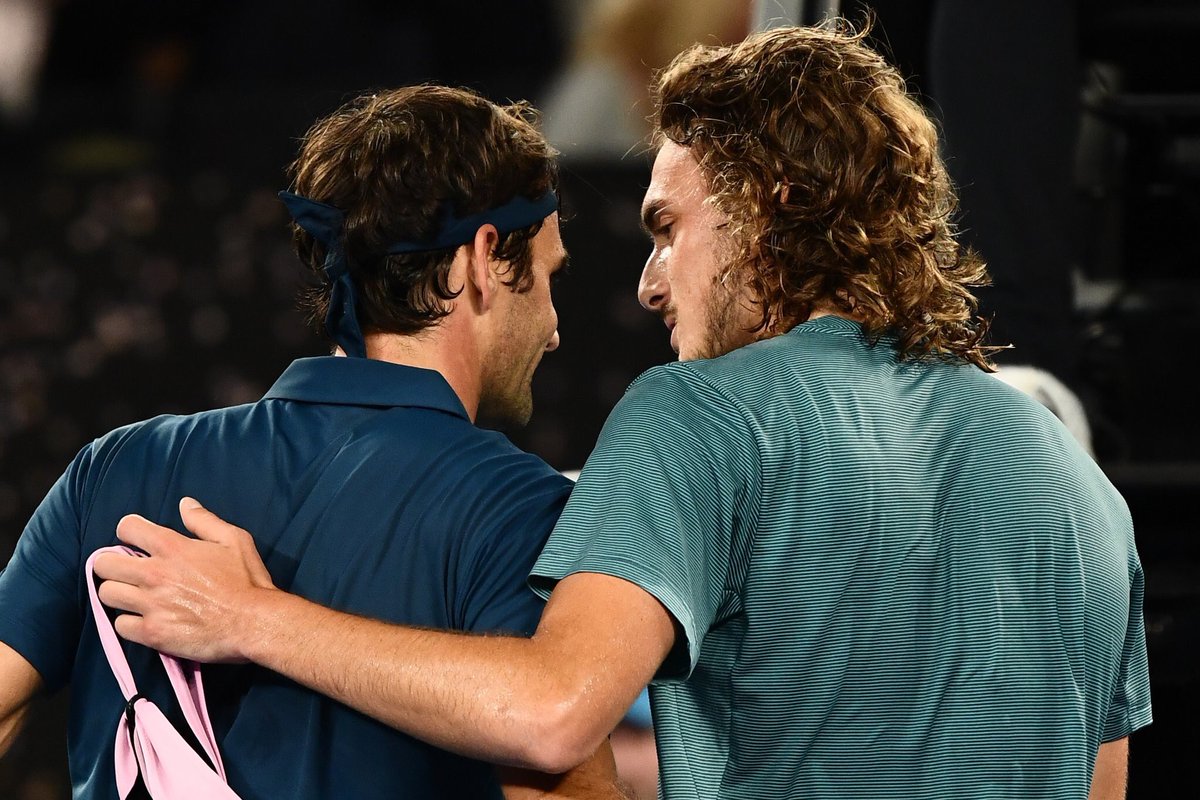
I woke up this morning thinking about two matches, both of which made me nervous about what was to come. The first match was the Sampras/Federer 4th round match at Wimbledon 2001. The parallels between that match and this one have been well discussed, but it was enough to make me nervous. Was Tsitsipas really going to be the Federer to Federer’s Sampras? I comforted myself with the knowledge that despite the comparisons, Federer has far surpassed Sampras as a player, as a statesman of the game, and generally as an athlete who has handled ageing with the kind of ease, ambition and dignity rarely seen in sport. In the immediate aftermath of his loss, I still believe this to be true.
The second match I thought about today was the Federer/Soderling quarterfinal at Roland Garros 2010, not that it was a parallel with this match today. Soderling was no newcomer, and Federer had won the opening set convincingly in that quarterfinal, before being clobbered off the court in the next 3 sets. It was the match that snapped his consecutive semifinals streak. Remembering this match today, I almost laughed at how dejected and heartbroken I felt at the time. I stopped writing, tweeting, and generally thinking about tennis for weeks. And now, almost 9 years later, few people remember or talk about that loss.
So perhaps in remembering these two matches when I woke up this morning, my subconscious mind had suspected that Federer might lose today, and then given me the tools to cope with the loss.
So here is what I have learned in the last 9 years about handling losses, even if they were losses you vicariously lived through.
- Early round losses are disappointing, but they rarely hurt the way the 2009 Australian Open hurts, or the 2011 US Open, or all of those losses where the end was tantalisingly close, when we arrived at match point only to have it wiped out in a flash. Compared to those losses, this was nothing.
- Early round losses also don’t mean much in the grand scheme of things, really. Millman? Robredo? Seppi? All tiny footnotes in the career of a giant.
- If you have enjoyed faves win all these years, you owe it to them to watch through their losses too. For me, that has always been the deal.
- Guess what? The guard has never stopped changing. Media narratives are so lazy. Whenever a young player beats Federer, it is immediately branded a “changing of the guard” without much thought or analysis. But the guard has never stopped changing, and Federer has never stopped fighting back and reinforcing his position. I recall a certain Serbian family declaring “the king is dead” more than a decade ago. But the old king is still here, defiantly playing on and ignoring those who are too quick to tell him ‘it’s a changing of the guard’. Ignore the noise, and focus on the man whose love for tennis has kept him at the top of the game for almost two decades.
Who’s actually excited about clay for once?
xx doots
Life lessons learned from a late career Federer
It’s a lovely problem to have (and one that I didn’t think I would ever have again) to be wondering what to write about after yet another Federer slam victory. To analyse the match itself would be to miss the bigger narrative here of records and Federer’s place in sporting history. To focus on history risks repeating everything that has already been said and will continue to be said about him – that Federer is GOAT. Duh.
I’ve been wondering lately about the impact that Federer has had on my life and it occurred to me that this late career version of Federer, this dad-joking, dorky legend in all our lunchboxes, has been a profound inspiration to me for the way that I approach my life and career, even more than the peak Federer of 06-07. So rather than focus on the title last night, here are some life lessons I have learned from late career Federer, gathered from my thoughts on 2017-2018.
- ‘Who cares, it’s just tennis!’
Not the reply that you expected from Roger Federer, but when asked by Courier after his semifinal win about whether he had a trophy room for all of his titles, Federer gave this unexpected response. He went on to say that he does enjoy going through some of them with friends at times, mentioning – among other things – his Olympic gold medal, not one of his more prominent career achievements, as something cool that he could share with them.
Watching this late career Federer, I couldn’t help but be struck by his ability to keep his success in perspective. This is in stark contrast to Bernard Tomic’s ‘I just count my millions’ comment when he crashed out of qualifying for the Australian Open. One player has done so much, yet prefers not to be reminded of his trophies in every room of the house, and enjoys sharing his successes with those dear to him. The other tries to seek comfort in money while failing to keep his demons at bay. Just a reminder that perspective, the ability to recognise that your life is larger than your profession, is a key measure of success.
- Love and cherish your community, and they will help you soar.
Last night, when Federer faced break points early in the fifth set, the entire Rod Laver Arena burst spontaneously into a chorus of “let’s go Roger, let’s go!” The crowd, who had been excited about the prospect of a fifth set late in the fourth, reverted overwhelmingly to cheering for Federer as soon as the fifth set began. It was clear that almost everyone bought tickets to see a Federer 20th.
Later that night, when the match has been won and Federer was presented with the trophy, he began his victory speech unexpectedly by paying respect to Australia – the cities he’s visited, the tournaments he has played here. His family loved Perth. He had loved his experience at the Sydney Olympics. And Melbourne has been worth the trip each time. It’s not hard to see why the crowd here has always supported him, despite a very Australian tendency to cheer for the underdog. And when Federer choked back emotions and could talk no more, Rod Laver Arena, and no doubt the rest of Australia, let their cheers do the talking for him. Have you ever heard anything like it?
- Big boys do cry.
While we are on the topic of tears, in a world of toxic masculinity and petulance, Federer has never shied away from expressing vulnerability. It is the thing that makes him endearing and authentic, despite living what appears to be a privileged and charmed life. Federer has shown that it is okay to cry on a big stage, that losses should hurt and wins should move you, and that the ability to let your emotions out can sometimes be a sign of a life lived with passion.
- All on board the gravy train.
‘It must be nice for Federer, now that everything’s gravy,’ said one of my co-workers as we both stole some time to watch tennis from the work kitchen. Indeed, one of the best things about late career Federer is that he has broken all records, and anything else he wins from here is just a numbers game. It presents a unique challenge for a player like Cilic, still with things that he wants to prove. How do you play someone with a mindset like Federer, who – in a completely different way – has ‘nothing to lose’?
At this Australian Open, Federer was the giddiest and most relaxed I have ever seen him at a slam, laughing with Courier post-match, turning on and off that ‘smouldering intensity’, giving insightful press conferences and actually enjoying the ancillary parts of a professional athlete’s life like media and PR. When asked on Margaret Court Arena last night about how he could keep going after 20 slams, Federer said:
‘Who cares about that part? It’s about winning and having a great time, seeing you guys now and celebrating all together. It’s so much fun.’
And isn’t it just? This connection between tennis audiences around the world and late career Federer stems not only from his successes, but from his apparent joy and delight in travelling the world and playing tennis. Federer is not only playing well at this stage of his career, he is actually having fun, savouring every moment and creating memories with his family, his team and his fans. And for me personally, working in a profession where some of the most successful people are also some of the most miserable, I am gratified that I have a role model who exemplifies the importance of enjoying your successes, of leaning into each moment that life brings you, expecting magic.
All on board the gravy train I say. Choo choo!
- The secrets of longevity
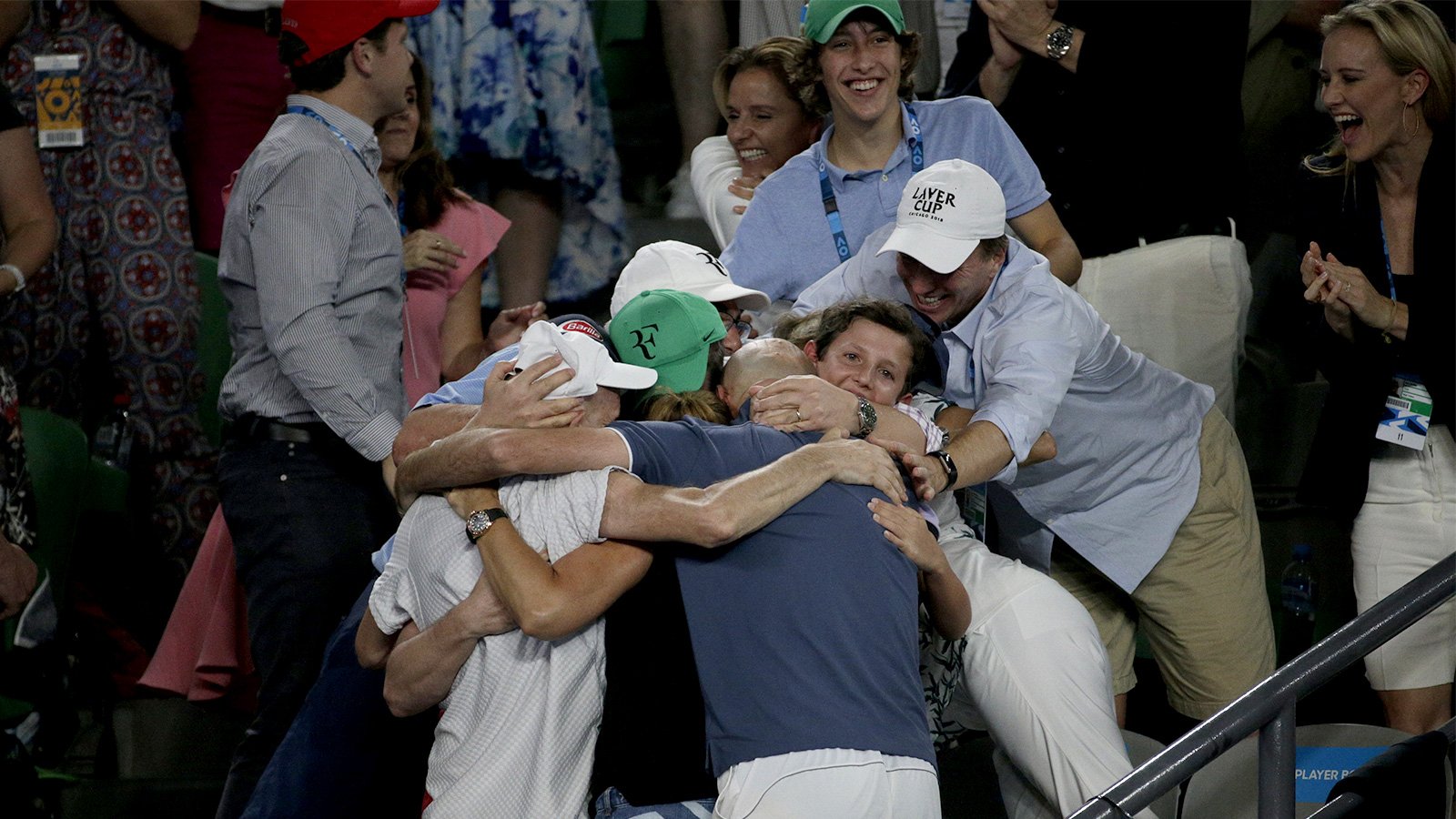
One overwhelming narrative of late career Federer is his longevity, and much of it has been attributed to his efficient playing style, which has kept him out of injury for much of his career. But there is much more to longevity than technical talent and efficiency. The mindset aspect of Federer’s longevity has been less discussed. I have already mentioned his passion for tennis and his enjoyment of life as a professional athlete, a given for anyone hoping to go the distance in their career. When asked about how he keeps his ambitions strong at this age and level of achievement last night, Federer gave a lot of credit to the people around him –
‘I think by not overplaying, not playing every tournament possible. I enjoy practice. Not minding the travel. Having a great team around me, they make it possible. At the end it’s seeing that my parents are incredibly proud and happy that I’m still doing it. They enjoy coming to tournaments. That makes me happy and play better.
Then, of course, my wife who makes it all possible. Without her support, I wouldn’t be playing tennis no more since many years. But we had a very open conversation, if she was happy to do this or not, years ago. I’m happy that she’s super supportive, and she’s willing to take on a massive workload with the kiddies. Same for me, because I wouldn’t want to be away from my kids for more than two weeks. This life wouldn’t work if she said no.
Many puzzles need to fit together for me to be able to sit here tonight.’
It’s again a wonderful perspective from someone who understands that success is about many moving pieces fitting together, and he is just one of those pieces, albeit a significant one. The secrets to Federer’s longevity, or anyone’s longevity in a particular profession for that matter, is about not overworking, having the right support system, your own personal Mirka, Seve and Ljubi. Or Papa Fed, that person who’s not afraid to tell you that you look like an idiot playing bongo drums.
As I embark on a personal career pivot of sorts this year, these are the things that I think about when I think about Federer. We can’t all win 20 grand slams, but each of us can approach life with passion, perseverance, and delight, drawing on the support of friends and family, and giving back to the community that gave us so much. These are the life lessons I have learned from late career Federer.
Happy 20th, Federbitches.
xx doots
Fail better.

A few years ago, while having dinner with a group of Federer fans, we came to the topic (as we do always) of Nadal.
“I still think Federer has a best-of-5 set win over Nadal in him,” I declared to the table, and was promptly mocked back to Basel.
“Nadal’s too in his head!” everyone said.
“It’s a bad match up for Roger!”
“Nah, it’s over.”
But somehow, I believed. Partly because I’m naturally inclined to optimistic delusions, and partly because – Federer being the kitschy fairytale that he is – this was precisely the kind of plot line that Federer’s career needed. The ageing veteran conquering his achilles heel. Beating the one rival who always eluded him. Redemption in the most emphatic of ways.
As his compatriot would quote:
Ever tried. Ever failed. No matter. Try Again. Fail again. Fail better.
This time, he failed better.
And make no mistake, he failed plenty in the final – going down a double break in the second set after playing first strike tennis most of the first set, losing momentum in the fourth after breadsticking Rafa just the previous set, taking a medical time out only to come out cold in the fifth and going down an early break.
But I kept thinking back to one of his more insightful moments in the semifinal post-match interview, when Federer acknowledged that his early losses against Rafa on clay affected the way he played him on other surfaces.
This level of insight was something that – just a few years back – he would get defensive about. Confronting and admitting the mental aspect of his struggles against Nadal appears to have been liberating, and this time, despite failing throughout the match to maintain momentum, Federer kept on asking the question, and found the answer to #18.
What else is left to say? 6 months off. Ranked #17. Coming into the tournament as the underdog no one talked about. Beats 4 top 10 players en route to the title. Defeats his greatest rival in 5 sets after being down a break in the fifth. And with this win, he has gone semifinals or better in his last FIVE grand slams. We could not have scripted this any better.
Happy 18th Roger. You just came of a whole new age.
#rideordiebitches
doots
(You didn’t think I wouldn’t resurface for THIS did ya?)
Roger: older and not quite out

A brief note before this brief post: I do have a new tennis writing position at an American-themed place called Fan Rag Sports. I have a really swell colleague, Trenton Jocz.
Here’s our homepage with Wimbledon coverage and other archives.
At FanRag, we decided in advance that I would cover the women’s quarterfinals and men’s semifinals. No duty on Wednesday, though, which is why I:
- Invite you to read Fan Rag’s coverage of the men’s quarterfinals, from other writers.
- Have to say something about that Roger Federer fellow here, in the wake of his stunning, stirring, old-man comeback over Marin Cilic on Centre Court.
I don’t want to steal my Fan Rag colleagues’ thunder, so this will be extremely short, but I have to offer at least one note.
*
No, I’m not here to mention various statistical milestones or any numbers which add to Federer’s growing collection of Wimbledon and major-tournament records. You’ve likely seen some of them, and will probably find them if you haven’t.
All I’ll mention in the wake of Federer-Cilic is simply this: Even into his mid-30s, Federer finds a way to settle scores. More specifically, he retains the ability to respond to some of his most crushing defeats with the sweetest triumphs.
Federer lost to Novak Djokovic in the 2010 U.S. Open semifinals after holding match points.
He beat Djokovic in the 2011 French Open semifinals.
He lost to Djokovic AGAIN in the U.S. Open semis after holding match points in 2011.
He beat Djokovic in the 2012 Wimbledon semifinals.
Few losses stung Federer worse, and yet he found ways to forge historically resonant triumphs over his conqueror months later.
Enter Cilic.
No one has to spend any time revisiting the 2014 U.S. Open semifinals. It was talked about to no end before and during Wednesday’s match. Federer, against the run of play and — frankly — the odds, has avenged that match.
He also said this:
Soul-crushing defeats can’t be wished away or shoved into a denialist position by Roger Federer or any of his fans.
The only thing he could do? Win the next time a moment really mattered.
That capacity remains intact, one month short of a 35th birthday, with a body whose fitness remains less than 100 percent.
It’s hard for a 17-time major champion to continue to amaze the sporting world. Roger Federer continues to do just that… somehow.
The Golden Era of men’s tennis: long believed, now official

Many of us felt it.
Many of us thought it.
Many of us said it.
Now, it’s very hard to deny it: This is the Golden Era of men’s tennis.
It’s still an opinion, but now the subjective statement contains the feel and flavor of an objective truth.
Novak Djokovic’s capture of his first French Open title on Sunday gave this period of the sport’s history its latest measure of massive masculine meaning.
Just exactly how can anyone argue against the Golden Era idea at this point?
*
In terms of entertainment value and newfound commercial respectability, perhaps 1976 through 1984 remains the most significant period in men’s tennis history. The sport — previously amateur, almost always played on lawns when outdoors, and therefore still tethered to a genteel identity in the eyes of most (the image persists for some Americans, even today) — became rough, tough, gruff and highly colorful in the late 1970s.
Borg. Jimbo. Mac. Lendl. Vitas. Splashes of originality, abrasiveness and pugnacity enabled tennis to come alive. Racquet technology began to evolve. Hardcourts busted up the grass-and-clay singularity of the major tournaments. Television began to give the sport mainstream visibility in an era before (and during the infant years of) CNN and ESPN. Tennis reached a lot of fans in that first period. People who might not have given tennis a second thought as a sport — as a fan, as an aspiring athlete, or as a sportswriter — gravitated to the game in those years.
If your motto is “the first movement is the biggest movement,” perhaps one can say — in a very narrow and specific context — that 1976-1984 is the greatest era of men’s tennis.
Otherwise, what began in the 2005 Roland Garros semifinals — when a teenage Rafael Nadal defeated top-ranked Roger Federer and began to build The Citadel known as Court Philippe Chatrier against his Swiss rival — is the finest and most luminous era men’s tennis has ever known.
Sunday’s events in Paris — on that same piece of crushed red brick — confirmed the notion.

The story of the Big Three is not a completed story.
We have seen both Roger Federer and Rafael Nadal bounce back from injuries before. Yes, the older they get, the harder it will be to reclaim past glories, but if nature and luck can conspire to usher them safely through the next three years, who knows how many delightful surprises they can provide?
Legends have been known to do things most mortals can’t. It is in the nature of a legend to transcend ordinary expectations.
Yet, let’s offer — just for the sake of creating parameters — the notion that Federer and Nadal don’t win another major title. (I know no non-Serbian person wants to think about that idea, but let’s briefly introduce it.)
Even if the two pioneering figures of the Golden Era don’t deliver another large-scale thunderbolt, this is what we can already say about Roger, Rafa, and the man — Novak Djokovic — who has both joined and eclipsed them with his championship at Roland Garros:
The Big Three:
- All won at least 12 major titles. Moreover, it’s a near lock that Djokovic will make this number 14 within the next year. Just contemplate that: Three men will win at least 14 major titles apiece. Three men will match or exceed Pete Sampras’s major-title haul. Three men — when they retire — will all share the the following distinction: None of their historical predecessors, not one, will own more major titles.
- All won career Grand Slams. Three of the eight men to ever collect championships at all four majors will have existed in this era, this 12-year period which still has a few years left.
- All tied or set the Open Era record for the most championships at one of the four majors. Djokovic owns the most Australian Opens with six. Nadal claims the most French Opens with nine. Federer doesn’t own an outright record, but he shares the record for most Wimbledon (7) and U.S. Open (5) titles in the Open Era.
- All set the match-streak record at one major: Djokovic won 25 straight Australian Open matches; Nadal 39 straight French Open matches; Federer 40 straight U.S. Open matches.
- All own or share the record for the most consecutive singles titles won at each of the four majors: Djokovic (Australian); Nadal (French); Federer (tie, Wimbledon, and tie, U.S. Open).
Even if Federer and Nadal don’t win another major, the two — with Djokovic — will create more records at the majors in terms of longevity, winning percentage, annual streaks, rounds reached, and more.
None of this includes the 81 combined Masters 1000 titles — placing the Big Three in the top three.
None of this includes all the times these three have left Andy Murray — owner of 10 major finals appearances, 19 major semifinals, and 12 Masters 1000 titles — at the altar of tennis history.
None of this includes some of the titanic matches in the sport’s history — Wimbledon 2008 (Federer-Nadal), U.S. Open 2010 (Djokovic against both Federer and Nadal), U.S. Open 2011 (Djokovic against both Federer and Nadal), Roland Garros 2013 (Djokovic-Nadal), and Wimbledon 2014 (Djokovic-Federer).
This is an unofficial statistic more than an official one, but if roughly two-thirds of the planet Earth is covered by water, roughly two-thirds of the book of tennis records has been covered by the Big Three since this era began… and that book will only acquire dozens of additional records in the years ahead.
Borg and Connors and McEnroe and Lendl knew how to fight and entertain, but the best player of the lot (Borg) didn’t stick around long enough to establish his legend in the stratosphere. Lendl is an historically underrated player, but he did lose all those major finals while enduring his Wimbledon curse. McEnroe burned out, an artist whose creativity was as fragile as it was brilliant once he reached a certain point in his career. As remarkable as he in fact was, Connors won only three majors outside New York and the U.S. Open. Even though he didn’t travel to Australia for a tournament whose prestige didn’t rise to a higher level until 1988, Connors still missed out a lot on the French Open and Wimbledon.
Never before has men’s tennis featured such dominance — primarily at the majors, but also in its second tier of tournaments — among a small group at the top. Never before has this sport formed such a brick wall, keeping underdogs out of the premises with near-total regularity. If one or two members of this Big Three faltered or suffered an injury, the other was there to hold the fort.
Each player could retire as the historical leader on one surface. Rafa is “El Rey de Clay,” Federer the top brass on grass, Djokovic poised to become the Elite of Concrete if he can stack together just two more hardcourt majors in the coming years. (He currently trails Federer in hardcourt major titles, 9-8, but he’s likely to hit 10 before he’s done.)
Getting tired of all these milestones?
They do all tend to blur together, don’t they?
Yet, that’s precisely the point: It’s impossible to keep track.
We were dazzled by Borg and McEnroe and Lendl and Connors 35 years ago, but we weren’t bewildered by the extent to which they swallowed up the record book.
Maybe the tennis fan of 2016 lives with a mindset that’s different from the tennis fan of 1981, but if the record books define a sport’s history, this era of men’s tennis has defined the profession with a sweep and scope we’ve never seen before… and won’t soon see again.
This is the Golden Era — no, it’s not a fact, but if ever an opinion felt like a fact, it does today, after Novak Djokovic completed one of this group’s final (and few) historical loopholes.
Nole, all day: Djokovic pushes his way into tennis immortality

Look at that cover photo. Look at that smile from Serbia’s greatest athlete. They are both worth more than 10,000 words.
Novak Djokovic, Coupe des Mousquetaires firmly and finally in his own mitts, could finally melt into satisfied relaxation. The one nicknamed Nole could — at long last — savor the blissful relief of completing his long climb of the French Open alps.
That long alpine climb was thwarted near the summit a year ago on the first Sunday of June. Interestingly enough, the alpine journey was stopped by a Swiss man. (Four years earlier, a different Swiss man stood in Djokovic’s way in Paris.)

The 2015 loss to Stan Wawrinka — a man whose last name was not Nadal — represented the kind of moment which can easily lead a hugely accomplished athlete to wonder if the fates have conspired against him. (This is not a reference to Djokovic, though many readers will jump to that conclusion. It applies to any athlete, not to him specifically.)
Bjorn Borg kept trying to climb the mountain at the U.S. Open, on different surfaces against different opponents in different finals. He came close, but couldn’t win a third set in a championship match. His failures in New York certainly played a role (perhaps not the central one, but clearly a supporting one) in driving him away from tennis at a comparatively early age. Had Borg won the 1980 U.S. Open final against John McEnroe, how different would his career — and the history of tennis — have become?
Ivan Lendl’s game was markedly unsuited for Wimbledon, or more precisely, the version of Wimbledon which existed in the 1980s, with a less robust variety of grass which easily gave way to a chewed-up playing surface. Lendl’s big takeback on his forehand enabled him to bludegon the ball on clay and cement (and carpet), but not on an uneven and torn surface in which any bounce during the second week of the tournament represented an invitation to disaster. Lendl knew he had to prepare religiously for Wimbledon if he was ever going to win it. He reached two finals, but a youngster named Boris Becker and a revenge-minded Australian named Pat Cash denied him in 1986 and 1987. Lendl was something of a cursed figure at Wimbledon, and he never completed the career Grand Slam as a result.
Pete Sampras was great enough to win 14 majors, but weak enough to not win at least one of them at the French Open. The greatest server in the history of men’s tennis couldn’t always blast his way out of trouble on red dirt, and so when the discussions of the greatest players of all time emerge, Sampras — certainly in the top six — will always confront that one glaring deficit on his resume.
So many greats of the game never won Roland Garros, and never won all four major tournaments. Yes, most rational tennis fans thought that after losing to Wawrinka, Djokovic (with Rafael Nadal at a more delicate and brittle stage of his career and Roger Federer focused on Wimbledon) would return to the French Open final. However, as history shows us, what seems logical — a great player winning a signature event at least once in a career — doesn’t always come to pass.
Players’ career achievements might deserve a given crown, but the players themselves don’t deserve a specific championship… not until they actually earn it.
Novak Djokovic had to climb that mountain.
Sunday, in a match whose specific contours contained some eye-catching historical notes but were rarely compelling on their own merits, the World No. 1 finally reached the summit in Paris.
Exhale.
Smile.
Melt.
Djokovic defeated Andy Murray in four sets. He became part of the third straight French Open men’s final in which the loser of the first set not only won the match, but won the next three stanzas. Djokovic learned from the recent past, because he was the man who coughed up one-set leads in 2014 and 2015.

Britain’s Andy Murray reacts as he plays Serbia’s Novak Djokovic during their final match of the French Open tennis tournament at the Roland Garros stadium, Sunday, June 5, 2016 in Paris. (AP Photo/Alastair Grant)
The progression of the match — Murray starting on fire, Djokovic rallying — might suggest that Djokovic surged ahead as the day went on. In terms of carrying the run of play, this is indisputably true, but in terms of the shift in power, it requires a little more unpacking.
In the second set of the 2015 loss to Wawrinka, Djokovic — perhaps burdened by nerves, perhaps struggling under a hot and baking Parisian sun which has often worn him down (see previous losses to Nadal in the heat) — lost energy. This drop in vigor enabled Wawrinka to step into the threshold and gain belief. The Swiss then soared in the third and fourth sets to register the striking upset which left Nole at the altar once again.
This time, the hinge-point second set was similarly decided by a drop in energy… but from Nole’s opponent, not the Serb himself.
The post-set lull is a trap door which ensnares even the best players (Roger Federer second-set walkabout, cough, cough). In championship matches, though, the best will either avoid it or overcome it. Murray, however — up one set to love after a tactically brilliant beginning to Sunday’s match — let the early part of the second set slide away from him in short order. It quickly became apparent, in the first stages of the second set, that even though Murray led on the scoreboard, it was up to the No. 2 seed to push through Djokovic and let the top seed know he’d be in for a fight.
Every reasonable inclination — early in that second set — placed the burden of proof on Murray to sustain a certain level of performance. The simple reality that the leading player shouldered such a weight in the second set, despite being a No. 2 seed making a third straight clay-court final plus a second straight major final, is not a commentary on Murray.
It’s a commentary on how great — how firmly formidable, how immovably imposing — Novak Djokovic has become.
This was not a match in which Djokovic had to push through Murray’s defenses. It could have been, but given the way the final three sets unfolded, that simply isn’t the case. As soon as Murray missed a sitter volley at 1-1, 30-40 in the third set, the flow of the match irrevocably spun away from the Scotsman’s grasp, never to return.
What was remarkable about a narrowly unremarkable match is that after a 2015 loss which forced him to push up the mountain, Djokovic played the final three sets of this final in a state of relatively easy control. He might have been stressed in the first set, and then again at the end after a 5-2 fourth-set lead very nearly became 5-5, but in between, he thumped Murray, winning 17 of 22 games.
Djokovic could have allowed this Sunday to be a chore, but all things considered, Nole made his crowning moment relatively uncomplicated. What’s therefore worth emphasizing is not that Murray had to push through him on Sunday (and failed), but that Djokovic pushed through Rafa and Roger years ago.
Before becoming the obstacle everyone else fights to topple in your given line of work, you have to overcome the obstacle.
Djokovic didn’t have one obstacle. He had two.
It’s not as though Djokovic is that much younger than (especially) Nadal or Federer, either. He’s only one year younger than Rafa, a contemporary in any real sense. If Djokovic was doing all this at an age five years younger than Nadal, we might view his feats differently. (This is something Federer and his fans will always be able to point to, but not in an unlimited way. I digress.)
That he’s very much a peer of Nadal — and had to play Federer several years ago, when the Swiss was not that removed from his prime period — magnifies Djokovic’s achievements to the fullest possible extent. The man who had only two major titles on his 24th birthday — with Fedal very much at the heart of the tennis universe, poised to dominate for many more years — now has 12 just after turning 29. That he shows no signs of stopping anytime soon — while Nadal and Federer deal with injuries and the realities of aging — is perhaps the greatest feat of all, the feat which will enable him to win 17 majors, maybe more.
*
Novak Djokovic is the obstacle Andy Murray and every other ATP player must push through in the present moment.
What’s amazing about this latest French Open final is not that Murray — despite a brilliant first set — had to continue to push through his opponent.
It’s that Djokovic pushed through the past — and Roger, and Rafa — to join his two fabled rivals as an owner of a career Grand Slam.
It’s that Djokovic has made himself untouchable enough that he’s actually exceeded Nadal and Federer with the freshly-achieved Novak Slam.
It’s that Djokovic, who labored for years under the standards set by a Spaniard and a Swiss, has now done something only Rod Laver had previously achieved in the Open Era (1969), and which no man has ever done (hold four major titles on three different surfaces).
Djokovic didn’t have the clear path — the barren field — Federer enjoyed in 2004, at the start of his ascendance. He didn’t have only one chief rival the way Sampras faced in the Agassi era. (There was no subsequent opponent of similar stature Sampras had to beat to win majors in his time — not normally.)
Sunday was not about subduing Andy Murray — Djokovic’s a better player, and will continue to remain that way.
Sunday was in many ways about forgetting the pain of the past — in 2015, and in all the years before 2011 when few of us expected Novak Djokovic to be this great…
… on the road to becoming even greater, now a part of men’s tennis at its greatest, most exalted height.
All that mountain climbing, all those alpine agonies, have given way to a view from the summit of tennis.
No wonder Novak Djokovic is smiling with such evident pleasure in that cover photo above.
Picket Fence sighting: yus I’m still around.

Okay, okay, I know. It’s been a while. If this was in real life, my picket fenced patch would be overgrown from neglect and infested with deadly Australian snakes. But it’s no coincidence that this blog went into its dormancy at the same time as the start of my career. A great time in the life of Doots, but some silent years for my little patch of cyberspace.
I was going to leave it like this, unloved and haunted by words from the past until “that post” when Federer retires. But strangely enough I was somewhat inspired today. Inspired in a way that I hadn’t been for a long time, and by a Federer loss no less.

It’s a strange phenomenon when you’re a Maestro fan who hopped on the Mothership during his years of triumph: learning to deal with mortality becomes the greatest lesson he’ll ever teach you.
So here goes five thoughts that couldn’t be contained by the 140 character limit on Twitter:
- The scoreline wasn’t close. And the first two sets certainly weren’t close. Federer is not the only player capable of “God-mode”. For two sets, Djokovic was in free swinging full flight – his groundstrokes met the lines from whatever position he was in, his passes always seemed to land in, even his defensive lobs seemed to come back in awkward positions for Federer. For a second, I (and many others) felt like this was going to be a repeat of the 2007 Australian Open semifinal, except this time, Federer was the one getting Roddicked. The commentators cried “poor poor Roger”, as if a losing fight against age and mortality, and attempting to beat a younger opponent at the pinnacle of his career was somehow making Roger less dignified. I don’t believe that, and I don’t believe in pitying anyone, least of all Roger Federer, who’s losing a fair fight on court.
- But it felt close in the end, didn’t it? Unlike Nadal at the French Open final in 2008, Djokovic snapped out of “God-mode” in the third set, and returend to being a mere mortal – albeit a formidable one still. But you could feel the tide turn when the crowd inside Rod Laver Arena chanted “Roger! Roger! Roger!” You could hear the deafening sound of hope when they cheered a Djokovic double fault in the third set just before Federer broke, only to shush themselves in embarrassment. And when Federer held off a tight service game to take the third set, it felt exhilarating. It felt – as tennis should – like anything could happen if you just keep at it. And suddenly, all of your reasons for sticking with “the Old Man” seemed to justify themselves in the roar of that crowd.
- Sport can be so cruel, and nets can be Serbian. It felt so wrong after Federer played the point of the tournament that the let cord should conspire against him. But credit to the player who had put himself in a 2 sets to 1 position in the first place.
- Was the third set fight back futile? Was it a mere salvaging of dignity when the end result was certain? Roger Federer could have walked off court today in a 3 set defeat, with the dominant narrative would have been that he has a new rival in his head; that he was past his prime and getting beaten by the young’uns. Instead, he walked away still defeated, but knowing that he was in it til the very end, that anything could’ve happened, and Djokovic didn’t get to Roddick him a la Australian Open 2007. It might matter very little in the ultimate result, but it could matter a great deal in a future match ups to know that he took God-mode Novak to 4 sets.
- Bring on that H2H. Federer will end his career with a losing record against many of his younger “rivals”, and that’s fine. Because he was truly peerless in his own generation.
There’ll be no return to “normal programming”, but I hope to pop up now and then when the occasion inspires.
Ride or die bitchessss.
xx doots
Goodbye And Hello: Sadness Followed By Opportunity

Theologically, as a Christian, I firmly believe we are all special.
As a tennis commentator, though, I assure you that I’m not very special at all. This is where today’s story begins. It is a story that contains several important personal and professional disclosures as I move into a new phase of my life and career.
*
PART ONE: CHILDHOOD
I didn’t play tennis competitively. The closest I’ve ever come to understanding a sport at its most cellular level is basketball, because I was a cameraman and sometime-statistician for my high school basketball team. (I received a tuition reduction in exchange for performing those kinds of tasks.)
However, there’s one thing I’ve done a lot in my life, more than just about anything else: I’ve watched sports. I consciously remember falling in love with American football in November of 1981 (on my older brother’s First Communion day) at the age of 5, and in 1982, I drank up everything I could about sports on the television screen and from the daily papers in Phoenix, Arizona, where I was born.
Yogi Berra, one of the great unintentional humorists not just in the history of sports, but in the history of human beings, has given the world many memorable quotes. One such gem is, “You can observe a lot by watching.” That’s pretty much my life in and around sports.
I’ve watched athletic competitions with great interest for 32 and a half years. Editors and publishers have given me opportunities to write about American football and basketball, because those are the team sports played at the university level here in the United States. I can write about those sports because I’ve watched them closely enough to know what’s going on and then convey my impressions to a reading audience.
When I began to fall in love with sports in 1982, Wimbledon and the United States Open did not escape notice. My first tennis memory is of John McEnroe becoming agitated late in his five-set loss to Jimmy Connors in the 1982 Wimbledon final. I recall Connors relishing the glory of triumph in his blue athletic jacket. That Sunday began a long love affair not necessarily with tennis, but with Wimbledon.
On Labor Day weekends, I would go to my grandparents’ house, where my grandfather would always have sports on when we came for Sunday or holiday lunches and a swim in the backyard pool. Labor Day in the States means the U.S. Open on CBS (though ESPN will take over the tournament next year). I grew up listening to the beloved Pat Summerall (one of the greatest announcers America has ever produced) and former major champion Tony Trabert. Virginia Wade joined the CBS commentary booth in the early 1980s, but when the decade ended, a young woman named Mary Carillo had entered the CBS broadcast set. She’s still there today.
Evert-Navratilova with splashes of Mandlikova and then the emergence of a young Steffi Graf. The McEnroe-Connors-Lendl wars, followed by the Year Of Mats Wilander (1988). Yes, the 1980s jolted me with the electricity that major tennis tournaments can create. I’ve followed Wimbledon and the U.S. Open ever since, and Roland Garros to a lesser extent. The Australian Open didn’t really stand on the same plane as the other three majors until the late 1980s (it didn’t have a 128-player field until then). Its emergence as a tournament worthy of the “major” label is comparatively new.
Speaking of new things, many elements of tennis coverage in the United States have just begun to become a regular part of the broadcast landscape. The Tennis Channel is only seven years old. Accordingly, American tennis viewers are only beginning to be brought in touch with tennis on an every-week basis over the course of the full season. A good 20 years ago, such saturation coverage could not have been found.
In the U.S., tennis does not enjoy the widespread popularity it received in the late 1970s and early 1980s, but there is a market for tennis content, and my relationship to tennis is a part of that story – not a special one or a big one, but one story that’s probably representative of many Americans.
It’s not a complicated journey. I followed the majors and was “a sports fan who loved tennis,” as opposed to “a tennis fan who also loved other sports to a lesser degree.” Roger Federer, though – with help from Rafael Nadal – took tennis to a whole new level a decade ago. Tennis became so compelling to me that I began to follow the sport on a more consistent basis, far beyond the majors. The convergence of added television coverage and increased personal interest has exposed me to more of tennis and the workings of the sport, both as an on-court drama and an off-court business.
No, I don’t fancy myself as an expert – I’m not even close to one – but can I make sense of what’s going on? Yes. Moreover, is there enough of a marketplace that I can find a home within it?
One company thinks the answer is yes.
*
PART TWO: TENNIS TWITTER AND A WORLD OF GRATITUDE
From 2006 through 2009 (maybe a little bit into 2010 – I’m frankly not sure), I was a regular commenter at Peter Bodo’s Tennis World blog, hosted by Tennis Magazine (now Tennis.com). It was at Tennis World that I learned about the vastness of the global tennis community. From my interactions, I learned how to not only talk about the sport, but listen to others’ views of it. My knowledge of what was happening on the court was supplemented by a growing awareness of how fans – of certain players and styles, and from certain nations – processed the sport.
When I joined Twitter in the spring of 2009, I didn’t know what the future would bring. I was beginning to tire of the incendiary nature of many commenters’ entries at Tennis World, but it was still my go-to place to talk tennis. I compiled a list of tennis tweeps to follow, but I had not yet experienced a major tournament with Twitter as the main web-based conversation place.
The 2009 Wimbledon tournament was my introduction to Tennis Twitter during a major, and I instantly found a lot of Tennis World friends in the realm of social media. Many of us had managed to carry our conversations from Tennis.com to Twitter, and we realized that while Twitter wars were not always unavoidable, we could still choose almost all of the people and conversations that appeared on our timelines. I was hooked, and many Tennis.com refugees felt the same way.
Moreover, Pete Bodo and his colleague, Steve Tignor, joined Twitter as well. Furthermore, other tennis writers were accessible on Twitter, so we – the fans of #TennisTwitter – realized that we could go to a single web source for “one-stop shopping” in terms of content and analysis.
Ten years ago, I might have gotten up in the middle of the night to watch an Australian Open match on ESPN, but that would have been the limit of my interaction with the match. Today, Tennis Twitter brings me to the web when I watch tennis matches at any time of day or year. In late January, I was watching a men’s semifinal (I forget which one; I know a Swiss guy was playing in it ;-), when this gentleman asked me if I had ever written about tennis before (for pay).
I said no… but that I’d love to be given the chance.
That chance was indeed granted.
Let’s absorb what happened: A CEO of a blog-based publishing company offered me the chance to cover tennis because I was a constant presence on Tennis Twitter. I know I’m speaking to the Picket Fence community here, but I’m even more broadly speaking to Tennis Twitter as a whole. YOU, Tennis Twitter, have helped me find a voice. YOU, Tennis Twitter, are responsible for what I’m about to announce:
*
PART THREE: CROSSING THE LINE AND A FAREWELL TO THE FENCE
I am not yet a full-service tennis blogger/commentator, but for 2014, I will be paid to cover Roland Garros, Wimbledon, and the U.S. Open at Bloguin. I will therefore cross the line separating the avid tennis fan from the paid worker. I’ll have to stand on the other side of this divide. This doesn’t mean I will be personally separated from Tennis Twitter, but it does mean that I now have a professional and ethical obligation to be accurate and fair in handling facts and information. (There’s always a personal obligation to be thus, but now that obligation is more binding and pervasive.)
The tenor or content of my tweets and writings won’t change dramatically, but they will change slightly at certain times. I won’t be writing for Federer fans or other specific segments of the tennis community. I’ll be writing for a general audience. That’s a responsibility which can’t be taken lightly.
I’m really excited about this opportunity, but these moves carry a price, and the cost of this transition is that I can’t write for the Picket Fence anymore.
The Fence has been a wonderful home for me. Julie Zhou – the hostess with the mostest – has been extraordinarily generous in offering me this space during the major tournaments and whenever a moment of inspiration emerged at other points during the tennis season. Doots, P.J., and L.J. have given a lot to me, all while they’ve entertained and delighted the larger community of Fed fans with their work over an extended period of time. I can’t thank these three Hall of Fame Federtweeps enough for giving me an added/fourth seat on The Fence.
This blog has enabled me to put tennis thoughts on paper, and I don’t think I’d feel as ready for this adventure at Bloguin if I hadn’t been able to provide Federer fan therapy after one of Roger’s semifinal or quarterfinal losses at a major (especially to Rafa).
It’s up to Doots to decide what to do with Le Fence in the future. She’s been busy becoming a kick-ass lawyer who will bring about substantial social change in the world. That’s kind of important, oui?
What my departure means is unclear, but I would venture to say only this: Perhaps there’s a Federtweep out there who would be interested in pitching in at the Fence (and submitting him/herself to a vetting process). If conversations develop about the Fence’s future, that alone would be a good thing, no matter what the ultimate decision or course might be. At any rate, though, this is something for others to decide, not yours truly.
*
PART FOUR: A COMMERCIAL AND AN INVITATION
As I said at the beginning of this piece, I am not a special tennis commentator. I’m not more knowledgeable than most. I’m not a former player, anyone who can offer a unique level of insight into tennis.
What is unique about me? Not myself as a person, that’s for sure. My story, though, is an uncommon one. How the heck did I get here?
I got here because I tweeted a ton about tennis. I imagine a few other human beings have been offered writing opportunities due to their tweets, but this is not an everyday occurrence within (paid) sportswriting. What emerges is that after five years of tweeting about tennis, I now get to sustain my interactions with Tennis Twitter, but in a different capacity.
Here’s what this means: Having shared so many lamentations and complaints with many of you about the way in which tennis is covered, I now get to be a part of “the media.” Sure, I’m at a lower end of the food chain, and I wouldn’t call myself a full-fledged journalist. (“Commentator” is the better word. I’m not doing reporting here.) However, I’m definitely in the arena.
I now get to attempt to represent you, Tennis Twitter and Picket Fence readers. I get to represent your views. I get to practice the art of media commentary as one who must be accountable to a larger audience. In short, I get to practice what I – and YOU – have been preaching. I think that’s pretty neat.
If you’re reading this, you have very likely joined me for at least some part of the past five years. You probably know what I think, but you’ve mostly gained that insight through tweets. Now, I get to unpack a lot of my thoughts in columns and expanded pieces. You might disagree with some of the larger conclusions I arrive at, but there’s nothing wrong with a disagreement.
My tennis writing position enables me to field questions, comments and criticisms from you, and to produce a work product that you will like. If you are frustrated with the way the media covers tennis, guess what? I might now be able to do something about it! Therefore, let me close with a short commercial about Bloguin, followed by an invitation to all of you:
*
Bloguin (it’s pronounced “BLOG-YOU-IN”) covers several American professional sports, plus college sports. Non-American tweeps probably won’t find most of those sports very interesting, but if you do, give Bloguin a look. What should definitely be worth your time at Bloguin in addition to my coverage of the remaining majors this year – this is true whether you care for American team sports or not – is partner site Awful Announcing, which looks at media issues and the ways in which sports are covered in the United States.
Want to understand the relationships that link money, production decisions, and event packaging? Awful Announcing will be your place to learn. Moreover, I’m definitely going to use my position as a tennis writer to address some tennis media issues at Awful Announcing.
When you visit Bloguin, you don’t have to click on ads. You just need to visit and share my articles. You don’t need to thank the people who hired me by sending them a note. You can thank them by visiting Bloguin and clicking my pieces. That’s how this enterprise works.
If this tennis experiment for the three remaining majors works out in 2014, Bloguin might enable me to cover more of the tennis season in 2015 and beyond. Facebook likes and Twitter shares will all go a long way toward ensuring that my tennis blogging career extends beyond 2014, so that I can continue to cover the sport – hopefully for a long time and for a partial living.
That’s the commercial. Here’s my invitation to all of you:
*
Contact me. Hold me accountable. If you like what I do at Roland Garros and appreciate my contributions to Awful Announcing on tennis media coverage, feel free to let these guys know. If you don’t like what I do, let me give you my e-mail address: mzemek@hotmail.com.
Stuff my inbox – I’m serious, please do when an article misses the mark or fails to meet your standards. Tell me what I’m doing poorly. Offer suggestions.
I’ll be open to what you have to say, and if I get a high volume of responses saying that the format of “Story X” doesn’t work as well as the format used in “Story Y,” I’ll be sure to use the format in “Story Y” as I move forward.
I’m saying goodbye to the Picket Fence, but I’m not saying goodbye to Tennis Twitter. Hopefully, as I say hello to the world of tennis media, your loyalty as readers and your continuous combination of advice and criticism will enable me to give you the tennis coverage you want… and richly deserve.
Thanks to all of you! I will see you at Awful Announcing and Bloguin, offering some tennis media pieces and tournament previews for Roland Garros.
This conversational relationship isn’t ending. It’s merely moving to places and forums on the other side of…
The Picket Fence.
Who the hell is dootsiez?

Melbournian lawyer. Blogger. Unapologetic Federer tragic.
Need to contact me? Pop me a comment here, or find me on twitter or through the contact form above the header.
Go on, I don't bite. =)
 All I need is a picket fence ...
Your thoughts …